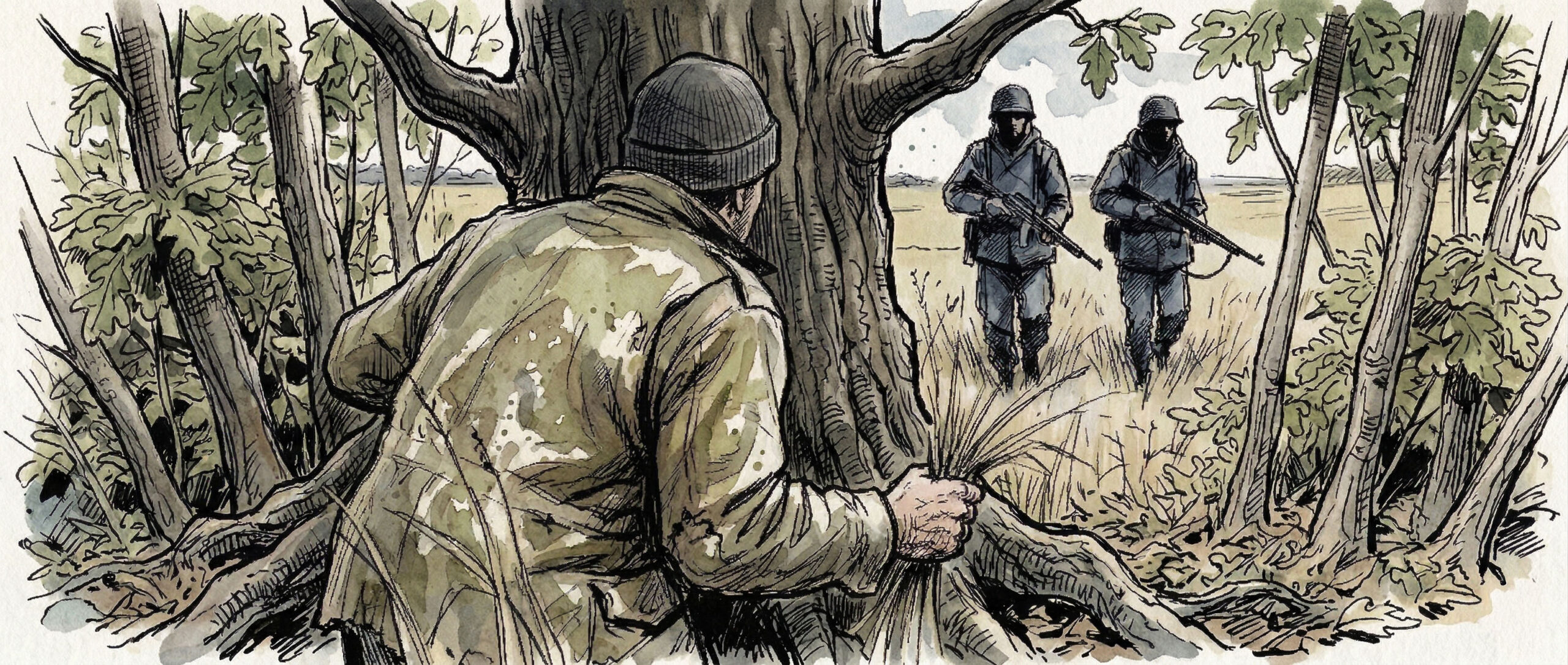
An F-15E Strike Eagle, shot down over Iran. Both crew members ejected. The pilot rescued within hours. The second airman, a Colonel, spent more than a day evading capture in the treacherous mountains of southwestern Iran, Iranian forces closing in, a bounty on his head. The CIA ran a deception campaign to throw the enemy off. U.S. special forces went in with heavy air cover and pulled him out of a mountain crevice.
“God is good,” he’d transmitted from his hiding spot.
He followed the principles of the Survival Course to a “T” even while seriously wounded from the ejection. And he survived.
This news of the daring, successful rescue struck eerily close to home for me. Not because I was downed and rescued, but rather because that never happened to me. Thank Heaven.
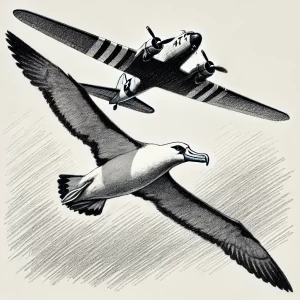
HOWEVER; As a C-130 airlift navigator, I flew 2,500 hours all over the globe, including in and out of that jungle paradise called Vietnam. But not before taking a short, but extremely rigorous Air Force Survival Course. Actually I completed two Survival Courses; the big one at Stead AFB, Nevada and a shorter, targeted course in Jungle Survival at Clark AB in the Philippines. The latter one was just before reporting to Vietnam for one year as an EC-47 Navigator. (And 1,000 hours at 1,500–2,000 ft over the Vietnam jungle in the oldest aircraft in the Air Force inventory; the venerable “Gooney Bird”, the C-47.)
Although it was over 50 years ago (yes, I’m old) the experience is indelibly etched in my feeble brain.
Both courses included a bunch about evading the enemy if you are forced to leave your aircraft. Getting hit by gunfire and being forced to violently eject from an F-15 fighter jet at high airspeed and altitude is a helluva way to leave it.
Our downed airman’s ordeal will be engraved in all future Air Force Survival School agendas.
Get away from your parachute landing place ASAP. Hide, but get to a high elevation to be seen and caught by friendly forces, not the enemy. Avoid people. Did I mention, “Hide”? Try to communicate so you can be identified. (In 1969 there were no iPhones or any pocket-sized phones one could carry into combat. How about a small glass mirror one could turn toward the sun and aim at an aircraft to get a pilot’s attention.) Stay calm and alert. Easy to say. Hard as hell to do. Hide and wait. Rescue will come.
It did.
Amen.
Here are some of my forever learnings from the “School” experience.
First. Don’t get captured.
The mock POW training taught me one major thing. They have total control over you. Food, drink, sleep, mobility, etc. Forget the John Wayne movie stuff. Try “name, rank and serial number” after no sleep, food or water for two days. And a few gun butts across your jaw. (They didn’t do that but they coulda.)
What else did I learn? Forget fairness.
After evading successfully, I was rewarded by 3 days in a mock POW camp. It was very real, but what made it “mock” was that it was for three days. You can stand on your head for three days. LOL.
Seriously, knowing it’ll end in three days or even three months means you can put up with a lot of punishment if you know it’s gonna end. If you’re a real POW, you don’t know if or when it’s gonna end. Big difference.
So do your damndest to evade capture. I demonstrated that in the Philippines, when during an evasion exercise, I hid in a clump of jungle and watched quietly as searchers almost stepped on me. I did not get caught, but was almost eaten alive by skeeters.
Lastly.
Make sure you have a good grip on the rope ladder when being pulled onto your rescue helicopter. I know of one MIA who was rescued and then lost his grip on the rope ladder about 10 ft from the helicopter entry, but 1,000 ft from the ground.
He wasn’t found.
Definitely enuf.